AUTOMATIC TRANSMISSION?

Some people wonder why I’m getting an auto and not a manual tranny. I’ve driven both. The manual is okay for shifting, not good or bad, certainly not as fast as the butter smooth Hurst I had on my ’68 Olds 442 (no notches at all). The auto also has a lower rear axle ratio and reviewers say the overall response is “muted” for the automatic.

The manual in the Shelby is an American Tremec. No significant issues.

All the other manuals in all other models of Mustang are Getrag. Getrag is a good Slovakian company that’s been around a long time and has made tranny’s for everyone, including very expensive cars. The parts are generally very rugged.

However the one for the Mustang is assembled in China. The 2011 Mustang showed problems with bolts backing out and the wrong fluid being used, plus maybe some other parts being thin and a shim being needed. It appears that the initial problems have been fixed, but it still makes me nervous because I can’t find any reports on the fixes in later years after someone has put on a lot of miles. My warranty on the powertrain is 6 years which at the rate I drive, is not a lot of miles.

I probably would be okay with the manual, but would be inclined to go with it only if it was a really fast shifter. I’m spoiled.

I’m not too concerned with the automatic getting off the line with 420 hp. It will still burn a long strip of rubber so I don’t really care if it does 0-60 one or two tenths of a second slower than the manual. The auto certainly will shift as fast or faster than the manual.

Ford says they could do as well or faintly better for acceleration times with the automatic compared to the manual.

For the year 2013, they added a switch on the shift knob so you can manually select gears, and it won’t over ride your decisions and will go nearly to full RPM.

There’s a little noise on the Net that Ford might’ve fixed the problems of the Chinese manual, but I’m sticking with an automatic anyway. I’ve read their official statement describing what they found and their solutions, and it appears reasonable overall.

Bottom line:

It will slam you in the seat as well as the manual and the top speed will be the same. It appears all regular V8’s are speed limited to 155 mph as best as I can tell.
It will be nicer to drive in Boston. The city gas mileage is slightly better than the manual.

Resale on Mustangs is average, but I’m predicting that within 10 years 2012’s and especially 2013’s will surprise people with their value once the public gets a load of the newer Evo Mustangs. Or at least the retro car enthusiasts.

I might’ve told you before that the GT can probably do 170 but is speed limited to 155. I imagine it’s the same deal with the 2013.

Premium fuel for the 2013 gets you 420 hp instead of the 2012’s 412. Apparently regular fuel for both cars is still 402 hp.
There are few reviews for automatics and this is one of the better ones:
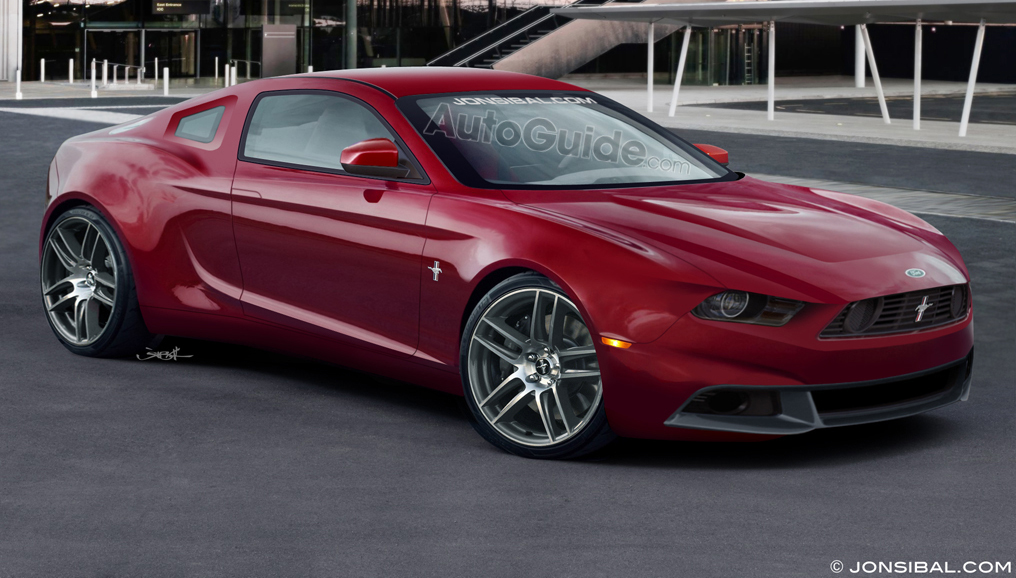
WHAT ARE THE FUTURE MUSTANGS?

2013 is the last year of the Mustang as we like to remember it.

I like the 2014 okay, but not as much. The 2015 seems pretty nice, but not the same as the 2013. So since I’m kinda hooked into that retro style, it’s 2013, which means I have to order a stripped automatic by about February give or take a month, according to my salesman. After that will only be 2014’s.

The 2015 is following the Ford “Evo” design trend and the 2014 is a bridge between that and the 2013. Of course the 2013 is a more muscular version of the 2012.

I’ve seen a secret photo of the rear of the 2014, doesn’t remind you an awful lot of a Mustang. All the rest for the 2014 and 2015 are artist sketches. You can pretty much figure out the trend.

The 2014 will be a little smaller than the 2013. The trend for the next 10 years appears to be making it more mainstream and less of a niche car. At some point it will be offered as both a 2 and 4 door. Kind of weird to think of a Mustang with 4 doors! But then again the Mustang II was totally bizarre, and the Fox body Mustang never really did much for me, either. It’s only the early ones from around the Bullitt era, the early Shelbys, or the ones from the past few years I like the looks of.

I DRIVE THE MUSTANG

I test drove a V8 Mustang with a 6 speed manual transmission and a V6 with a 6 speed automatic. I have to say by the way that I highly recommend the V6 as the low price, 305 hp and 31 mpg can’t be beat. The car took off fast and I couldn’t find anything wrong with the shift points in the automatic, either. I couldn’t think of any way Ford could’ve done it better.

Needless to say, the 412 hp in the V8 (420 in the 2013 I’ll be buying) was outstanding. What a friggin’ engine! This 5.0 has nothing to do with any past 5.0’s by Ford. Four variable in and out cams and sequential injection. Ford didn’t figure direct injection was worth the extra cost and effort at this time. I know I’m not missing that at all!

This model is called the Coyote engine and all reviewers regard this as the car’s greatest feature. The power band is smooth with no dead spots as you rise in RPM’s. 420 HP at about 6100 RPM’s and 390 pounds of torque at about 4600. If that 6100 RPM seems way too high, it’s not, as this V8 revs up to 7000-7300! The Boss 302 version is 7500, and has been verified stable at 8400!!

I’ve never had a car that could rev past 5700 or 6000 tops.

But the great news about this engine is that you DON’T have to rev it high to make it come alive. Reviewers comment a lot how you can pretty much be driving any speed in most any reasonable gear and no matter what, it will pull nice when you step on it. Even though my test drive wasn’t really long, I can verify that. It just feels really nice. My Olds 442 had a police grind cam shaft in it and it could do that, too. Hey, Ken and Mary, do you remember that?

I had a 1965 Ford Fairlane with the (again, another famous) 289 cubic inch engine. Very good engine. These ranged from 200 to 271 hp in old ratings. At today’s ratings, 180 to 244 hp. This new engine is 5.0 liters or 302 cubic inches. Interesting to think that an engine that’s only 4% bigger has 72% more power than the best 289! A lot has happened in the last 47 years.

My test drive with both Mustangs consisted of leaving Grappone’s lot and getting on 89 at the junction of 89 and 93. We headed out to Exit 3, Stickney Hill Rd. On the way there in the V8, I hit 100 mph in no time at all. My salesman Robb chose this route to demonstrate how good the car is on a lot of turns with a lot of bumps. I was expecting worse with the solid rear axle and told him I was surprised how good it was. After Stickney we worked our way over towards Jewett than back onto 89 at Exit 4 and back to the dealer. It was plenty sufficient to check out rattles, handling, shifting, braking, acceleration, etc. for both cars.

I was super careful scrutinizing exactly what was going on with the automatic transmission. I couldn’t find anything to complain about when I was doing all kinds of stuff with the gas pedal.

I have only two complaints with the car.

The seats are not the best or worst I’ve had. If zero is the worst I’ve personally owned and 100 the best, these would be about a 45 to a 60. I’m not spending a lot extra for the Recaro seat option as they have no heat, and I’m not sure if I’d like the comfort of them or not. I’ve never experienced them. I’m sure the support is better but have no idea about the comfort.

The support of the standard seats is fine for me as far as the side bolsters are concerned. But I have a skinny ass that will probably be okay with the seat bottom on a long trip. My Buick is perfect in that regard. IF the Mustang proves not so great on a really long trip, I can keep a memory foam cushion in the trunk, I suppose.

It’s too bad you can move the steering up and down but not in and out. A telescoping wheel would really be useful in this car, but I’m probably more flexible than many people my height of 5’10” when it comes to seat position, so I didn’t think it was a deal breaker for me. I still think that without a telescoping wheel, Ford should’ve had that wheel closer by at least a half an inch if not an inch. Professional drivers like Randy Probst who REALLY know how to evaluate nuances have not complained about it at all.

Overall, I really like this car and feel fine about making the investment. Even though I’ve bought a few new cars off of lots in the past, I’ve never ordered from the factory before. I cannot ever find a car anywhere that has the options I want and I refuse to pay for options I don’t want. I have a tight budget.

The car feels and sounds great. My 442 was 360 hp or 330 by today’s standards. Even though it was surprisingly a little lighter than the Mustang, the aerodynamics of the Mustang are better, the 442 had only 4 speeds, and the Mustang is almost 100 more HP. The 0 to 60 time of the Mustang is about 2 seconds better! So I’m gonna really dig this car.

WHY NOT A CAMARO?

Why did I choose the Mustang?

I didn’t bother to drive the Challenger. The base V8 was competitive in price but not performance. To get one that’s competitive, you have to get the SRT8 version for about $8000 more, so that was out of the question. I like the looks of the Challenger a lot and it has the most room and comfort, but it doesn’t fit my requirements for both performance and cost.

Banks is the dealer where I take my Buick for maintenance. I test drove a Camaro V6, which automatically was going to have better handling than the V8. I took it up Oak Hill Road in East Concord which I know extremely well. Lots of dips up and down, bigger climbs up and down hills, lots of twisties. Cool to drive on but you have to be paranoid about nailing a bike or pedestrian (rare, but you never know on that road). Most of the twisties are very blind. I ride my bike there a few times a year but am always listening for cars when I do and am prepared for everything.

It was a nice drive as far as handling was concerned. The V6 felt fine at around 305 hp like the Mustang V6. However I noticed some weird things that were a turn off.

Some of the controls facing you ahead of the center console are kinda goofy looking. They remind me of something that would’ve been designed by Mattel. Perhaps it’s significant that the Camaro was prominently featured in the Hasbro Transformer movies. The rest of the dashboard had a lot of personality, but it was a personality that didn’t do much for me. Still had too much Hasbro in it for me. Or something.

Before I drove the car I remember reviewers complaining about the steering wheel. What Chevy did was put strange notches in the wheel just above the left/right spokes. These would be where you’d have your thumbs poking forward when gripping just above 9 and 3 o’clock. Or possibly your index finger also coming back to sort of meet your thumbs.

Reviewers said this groove in the steering wheel forced your thumb to be straight instead of letting it wrap around the wheel. I also noticed a sharp angle that was odd feeling to my index fingers. Was it tolerable? Yes. Was it annoying? Yes. Was it a good idea? I have no idea why Chevy thought it was a good idea. I heard noises that since I drove the car, the steering wheel was gonna go back to “normal”, but I don’t know if they made any change for that.

I have to say that I like the look of the Camaro just fine, which is also has to be the biggest reason why it outsells the Mustang. It’s retro but with a stronger modern thrust. The angularity of the design reminds me a bit of the Cadillacs. The Mustang is also retro but with smoother lines. It’s also smaller and more nimble. The Mustang 5.0 V8 is smaller and lighter than the Camaro 6.2 V8, which also means better front end handling.

If you were to spend an awful lot of time flailing cars around jiggly bumpy turns, the independent suspension in the Camaro would be a better choice than the Mustang. However the Mustang’s solid rear axle keeps the wheels planted better on the straights and for hard acceleration. Also Ford did an exceptional job designing that solid axle to the extent you often really don’t care it’s not independent. This also kept the cost down.

What’s one of my biggest beefs with the Camaro? The visibility!

Now, I would really love to have a 1950 custom Mercury lead sled, chopped and channeled to death. You know, like the red one in American Graffiti. The windows are like gun slits in a turret. But that’s not a daily driver.

Well, the Camaro is not quite that bad, but I’ll say that the Mustang visibility is acceptable and not disconcerting. The Camaro visibility is annoying and the blind spots are terrible. When you sit in a Camaro, you sit DOWN IN the Camaro. The first impression is that the belt line or the bottoms of the windows are about level with your nose. Not really, but that’s the first thing you think of.

In the Mustang you have to be aware of a couple potential blind spots, but they are helped immensely by well done blind spot mirrors inserted in the outer upper corners of the side mirrors. Even without those, the blind spots in the Mustang are not nearly as bad as the Camaro.

When you sit in a Mustang, you sit ON the Mustang. Think of sitting on a horse, or………um, sitting on a mustang.

I can’t think of his name at the moment, but a professional driver I respect said that you feel the rear of a car with your ass and you feel the front of the car with your hands. How well all that works depends a lot on the feel you get once you’re planted in the car. Of course I’m sure I could get used to anything, but the immediate impression for driving control is better in the Mustang than it is in the Camaro.

What would give you a better feel for control? Sitting on top of a saddle with steering wheel the right size even if a bit forward, or sitting in a bathtub with an odd steering wheel that’s faintly bigger?

I decided between the visibility, the steering wheel and the Mattel dashboard, the Camaro was not for me. I also knew the front end of the Mustang would steer better than the Camaro when comparing the V8 models.

MY TIME TO BUY A MUSTANG

It became apparent to me that I could possibly have an affordable performance car after years of doing without one. I had a 1968 Olds 442 (360 hp), a 1985 Saab Turbo and a 1989 Ford Merkur Turbo (made in Germany). Most other cars were nothing special, though most had plenty of power as most were medium or large block V8’s.

My current car is a 2005 Buick LeSabre with the famous Buick 3.8 V6 that feels plenty more powerful than it appears on paper. Essentially that engine has been around in with different heads for about 30 years or more. They got rid of it after 2008. My heavy Buick can move well and can get 33 mpg on the way to Boston at 67 mph. Also one of the best front wheel drive cars for getting through snow because it’s heavy up front.

I realized that a stripped V8 Mustang or Camaro was about $32,000 and within the realm of financial possibility if I could get a decent trade in for the Buick. So I started planning how to save and took some test drives.